Joongwon Chae

Master's Student Researcher · Tsinghua University, Shenzhen International Graduate School

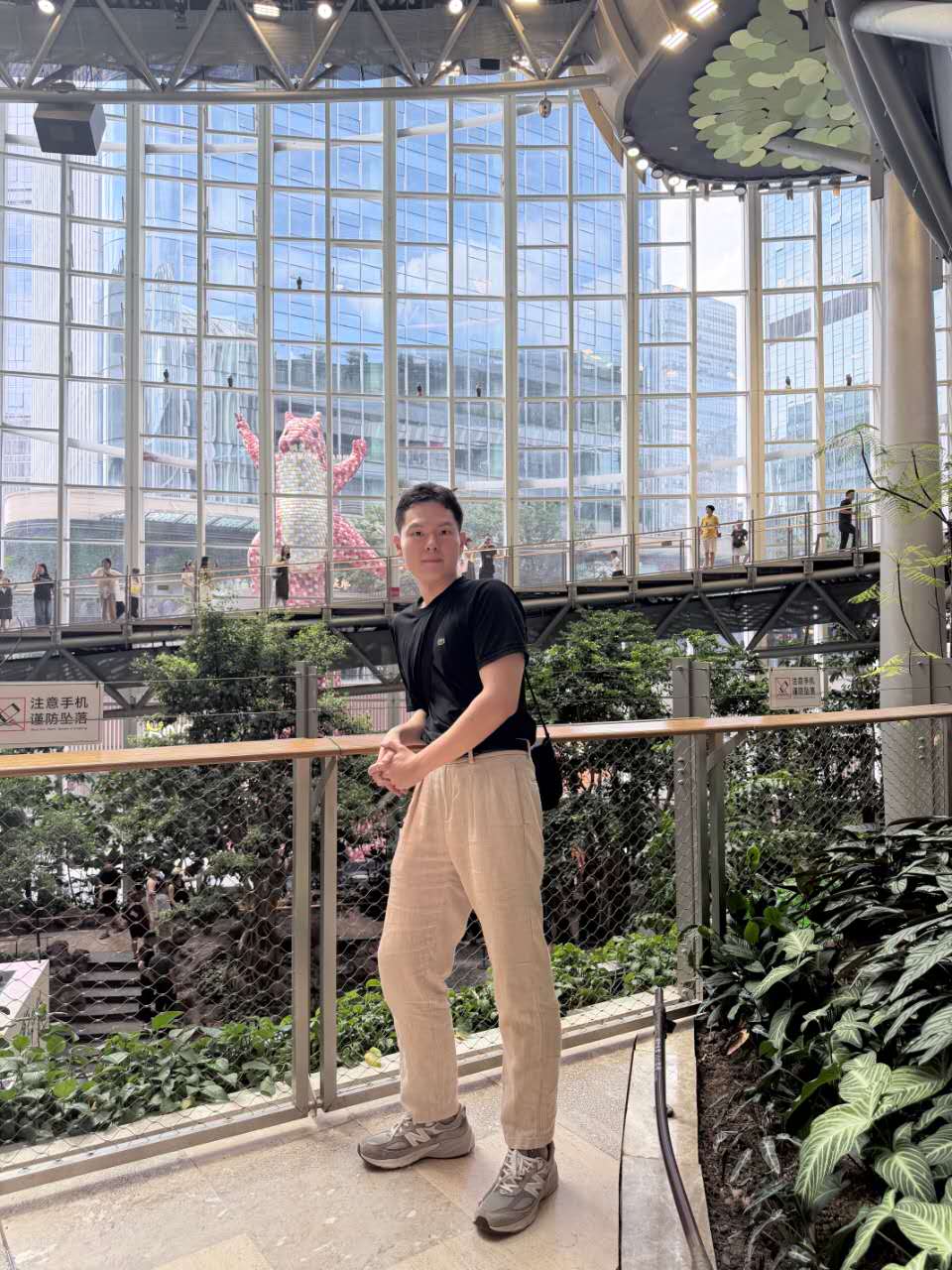
Joongwon Chae at a bright indoor botanical atrium
Shenzhen, China

Bio

I am a Master's Student Researcher at Tsinghua University, Shenzhen International Graduate School. My work focuses on training-free visual inference: systems that select and use reference evidence without updating the underlying model.

I build training-free visual systems around a central question: which reference evidence should a frozen model retain, route, and trust?

My work spans memory composition, projection-consistent selection, continual routing, and retrieval-to-prompt segmentation.

Selected Research

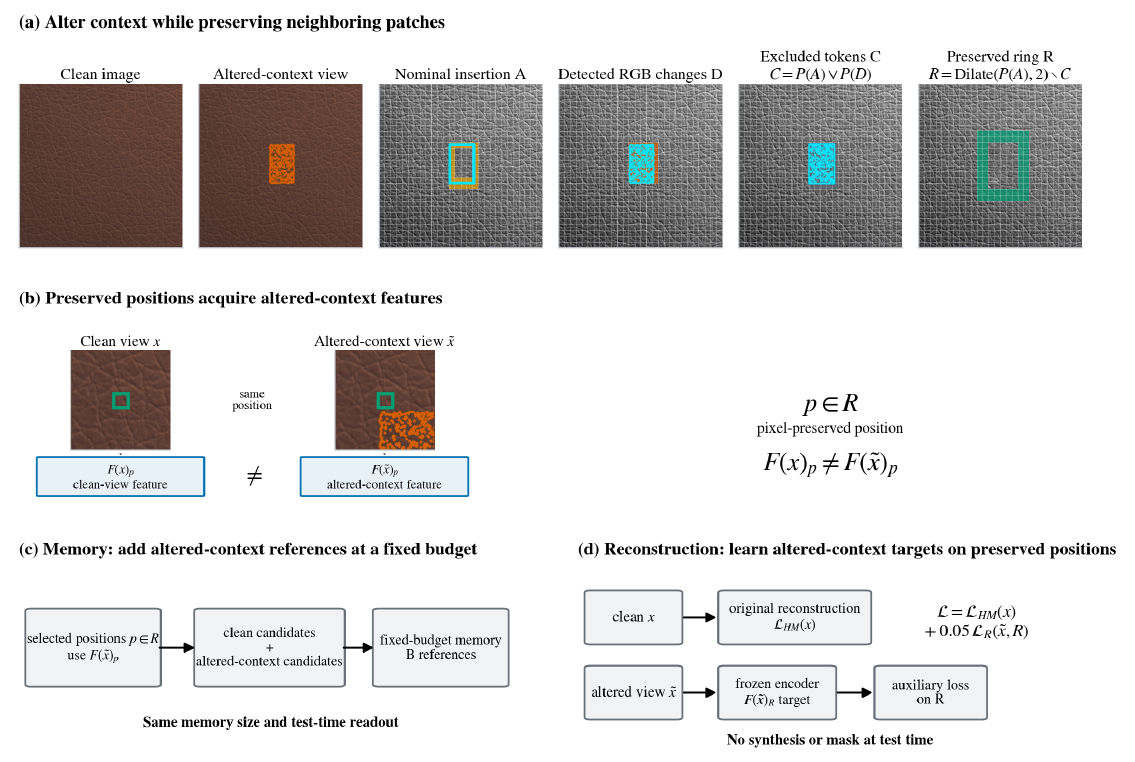
BoundarySupport framework showing altered context, pixel-preserved neighboring patches, fixed-budget memory, and reconstruction targets
BoundarySupport changes context while learning only from pixel-preserved neighboring patches.

Under review at ICLR

What Remains Normal?

BoundarySupport: Clean Images Miss Useful Near-Defect Normal Patches

Topic
I test whether clean training images contain all normal evidence needed to localize defects, especially for normal patches beside real defects.
Method
I introduce BoundarySupport: controlled synthetic context changes expose new features at pixel-preserved neighboring patches, which become fixed-budget memory references or reconstruction targets.
Algorithm
I exclude every token intersecting the nominal insertion or any detected RGB change, keep the pixel-preserved two-token ring, and use its altered-context features as normal evidence.
Result
At a fixed memory size, near-defect normal patches raise MVTec P-AP from 73.34 to 76.95, and a two-cell band recovers 94.70% of the gain. Across three paired seeds, BoundarySupport improves P-AP in all six memory and reconstruction settings.
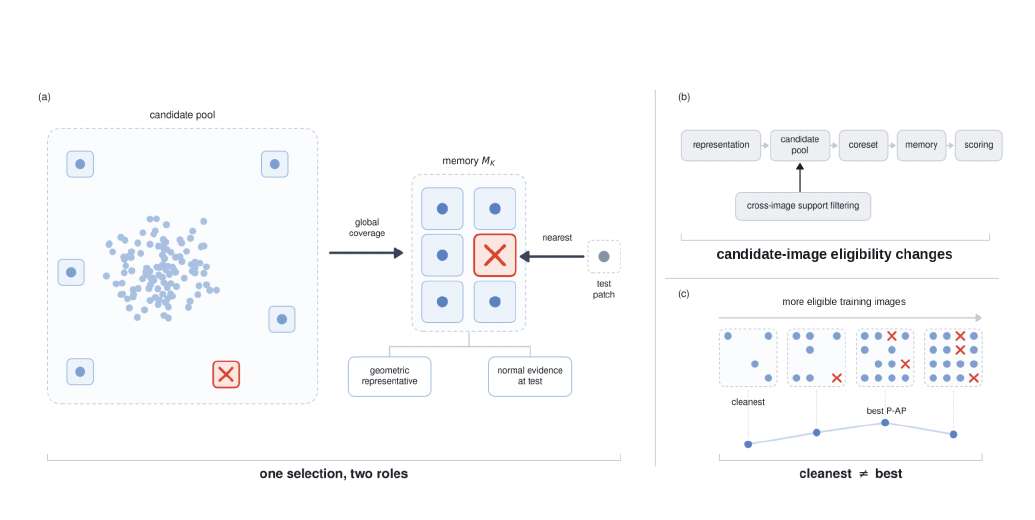
CLEANCON principle separating candidate-image eligibility from a fixed global memory builder
CLEANCON separates candidate eligibility from the fixed memory builder to test why the cleanest memory is not always best.

Under review at ICLR

What Memory Composition Does Not Tell Us

CLEANCON: Memory Purity and Memory Utility Are Different

Topic
I examine how coverage-driven memory selection can turn sparse contamination into deployed normal references, and whether a cleaner memory is actually better.
Method
I introduce CLEANCON, an out-of-bag cross-image support gate that changes candidate eligibility while keeping the encoder, absolute memory budget, builder, and inference rule fixed.
Algorithm
I score each image by the top 0.5% of patch-wise soft-projection residuals from 20 out-of-bag support banks, take bank medians and a cross-depth mean, and pass the lower-risk half to the unchanged memory builder.
Result
At a 1% memory budget, Global FF amplifies sparse contamination by 16.04 to 40.61 times. CLEANCON drives final-memory contamination to approximately zero and improves category-macro P-AP in all 12 matched comparisons, while the cleanest memory is not the highest-performing one.
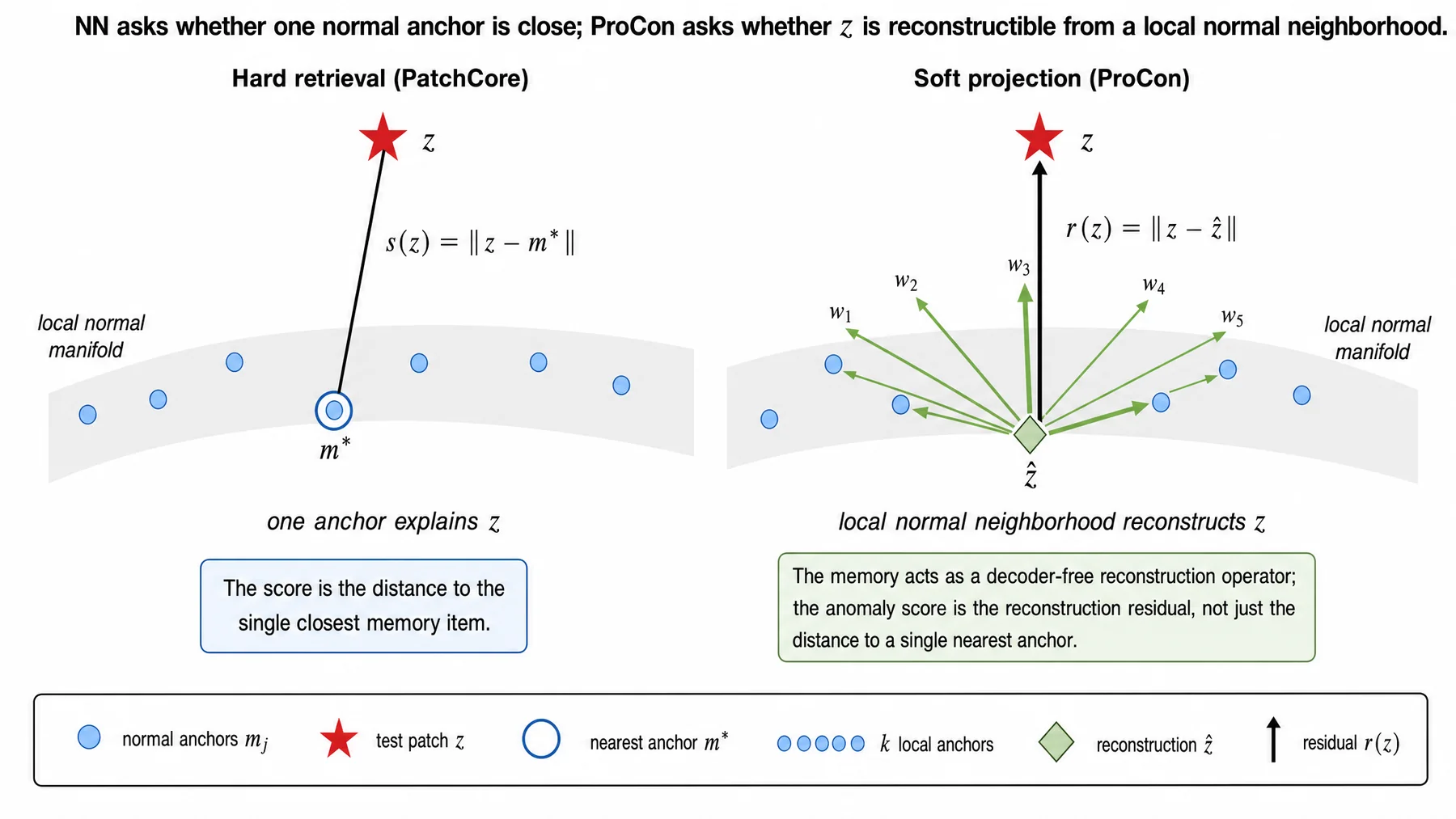
ProCon comparison between hard nearest-neighbor retrieval and soft local projection
ProCon replaces a single nearest anchor with local projection.

Under review

ProCon

Projection-Consistency Memory for Training-Free Anomaly Detection

Topic
I ask how a frozen anomaly detector can select useful reference memory by internal consistency rather than raw nearest-neighbor coverage.
Method
I introduce ProCon, a training-free, decoder-free reconstruction framework that replaces hard nearest-neighbor lookup with soft projection onto normal memory.
Algorithm
I soft-project each test patch onto a local normal neighborhood, take the median residual across seed-perturbed memory banks, and average the residual maps across feature depths.
Result
With a frozen backbone, we achieve image AUROC of 99.8% on MVTec AD, 99.2% on VisA, and 93.2% on Real-IAD.
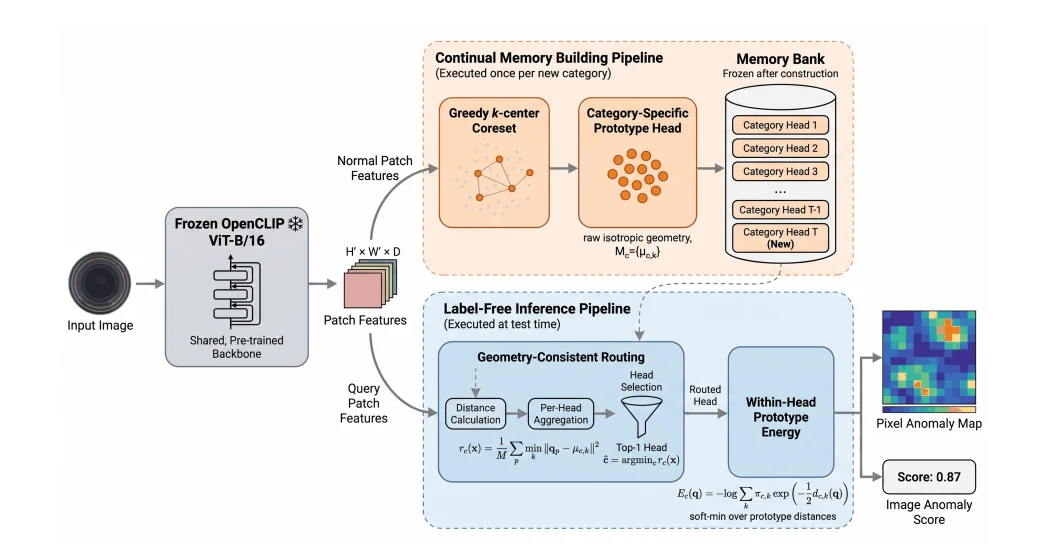
GCR pipeline with frozen OpenCLIP features, category prototype banks, geometry-consistent routing, and anomaly scoring
GCR separates cross-head routing from within-head anomaly scoring.

Under review

GCR

Geometry-Consistent Routing for Task-Agnostic Continual Anomaly Detection

Topic
I study how a task-agnostic continual detector can route each test image to the correct frozen head without being told its task identity.
Method
I introduce geometry-consistent routing, separating cross-head prototype geometry from within-head anomaly scoring so new tasks can be added without retraining old heads.
Algorithm
I route each image by the mean nearest-prototype distance over 32 sampled patches in shared frozen space, then compute LogSumExp anomaly energy only within the selected head.
Result
On MVTec AD and VisA, we show that GCR substantially stabilizes routing and keeps forgetting near zero without end-to-end representation learning.
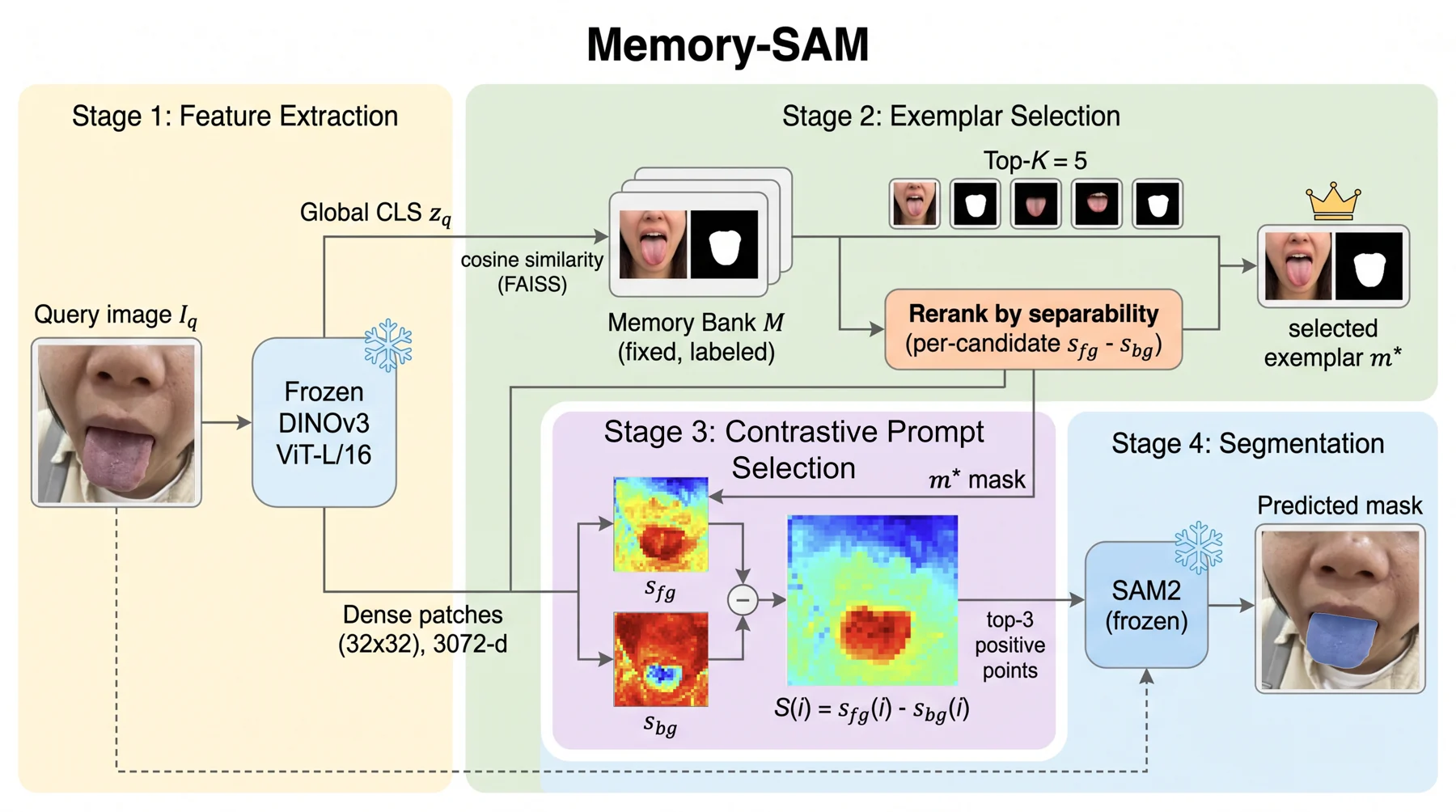
Memory-SAM architecture for exemplar retrieval, contrastive point selection, and SAM2 tongue segmentation
Memory-SAM turns foreground-background DINOv3 contrast into automatic SAM2 point prompts.

Under review at AAAI 2027

Memory-SAM

Human-Prompt-Free Tongue Segmentation via Retrieval-to-Prompt

Topic
I study how a small labeled memory can generate reliable SAM2 prompts across controlled and unconstrained tongue images without manual prompting or parameter updates.
Method
I retrieve candidate exemplars with frozen DINOv3, partition their features with expert masks, and rerank them by foreground-background separability on the query.
Algorithm
I subtract background from foreground DINOv3 similarity, S(i) = s_fg(i) - s_bg(i), select the top three foreground contrast points, and use them as SAM2 prompts.
Result
We achieve 0.984 mIoU on HIT-Tongue and 0.973 on the 2,155-image SM-Tongue smartphone benchmark, and release 2,155 de-identified 512 x 512 image-mask pairs. Earlier versions received average reviewer scores of 24/28 at ICASSP 2026 and 4.0/5.0 at MICCAI 2026.

Recent Publications

Academic Record

Experience

  • Master's Student Researcher, Tsinghua University, SIGS2024-present
  • Research Intern, Ratel SoftJul 2025-present

Education

  • Tsinghua University, Shenzhen International Graduate School2024-2027 expectedM.S. in Electronic Information (Biomedical Engineering), Institute of Biopharmaceutical and Health Engineering. Advisors: Peiwu Qin and Runming Wang.
  • Shanghai Jiao Tong University, Department of Automation2018-2024B.S. in Automation.

Honors

  • Excellent Student Scholarship, First Class, Tsinghua University, 2024
  • Yingcai First-Class Scholarship, Tsinghua University, 2025
  • Tsinghua University International Graduate Tuition Scholarship, 2025-2026
  • Shenzhen Universiade International Scholarship Foundation Scholarship, 2026

Languages

Korean (native); English (IELTS 6.5); Chinese (HSK 6); Japanese (JLPT N2).